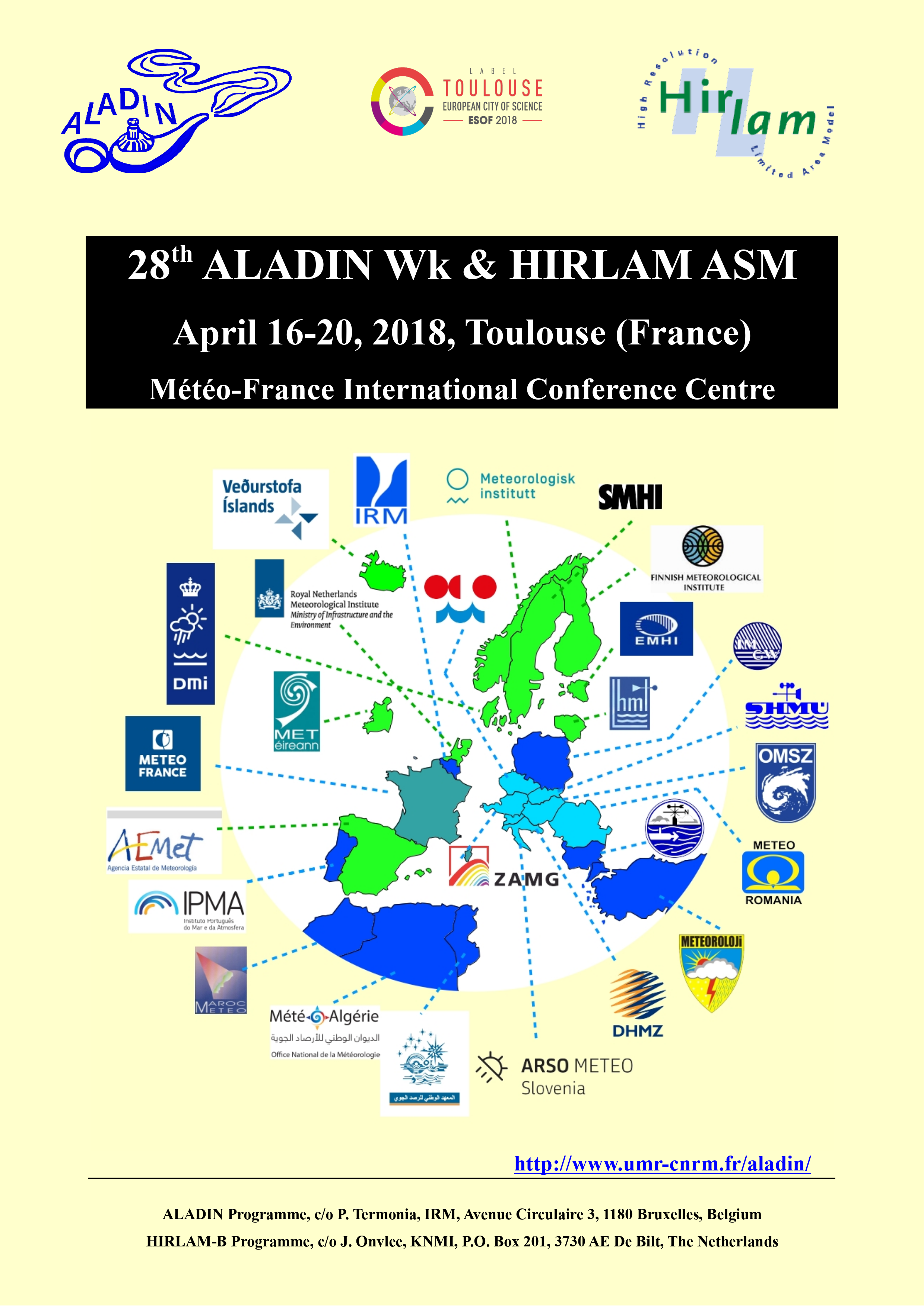
The joint 28th ALADIN Wk & HIRLAM ASM 2018 will be held on the premises of Météo-France in Toulouse during the third week of April 2018.
- 16 April 2018, 08:30-20:00 : opening session, DA session, Posters session and LTM meeting, icebreaker
- 17 April 2018, 08:30-19:00 : Physics and Dynamics sessions, Surface WG, Climate WG
- 18 April 2018 08:30-22:00 : Verification and Surface sessions, visit and official dinner
- 19 April 2018 08:30-22:00 : EPS and System sessions, System WG; HARP WG,
- 19 April 2018 20:00 : Public conference by Laure Raynaud (pdf of the presentation, video of the presentation), in French, title: "Vers une prévision des incertitudes en météorologie" [1]).
- 20 April 2018 : HMG/CSSI meeting (08:30 - 17:30), for HMG/CSSI members only.
It was possible to remotely attend the Sessions using a dedicated WebEx conference. The sessions were also recorded and the videos are available (see below links in the agenda).

This joint Wk/ASM obtained the label "EuroScience Open Forum 2018 - TOULOUSE, EUROPEAN CITY OF SCIENCE".
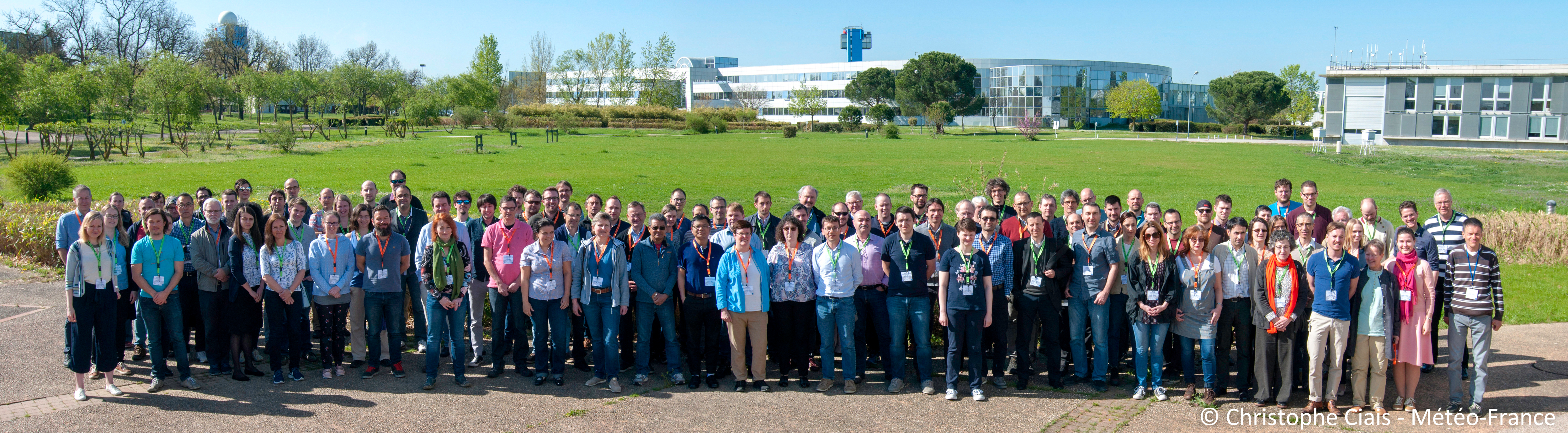
28th Wk&ASM 2018 : participants
|
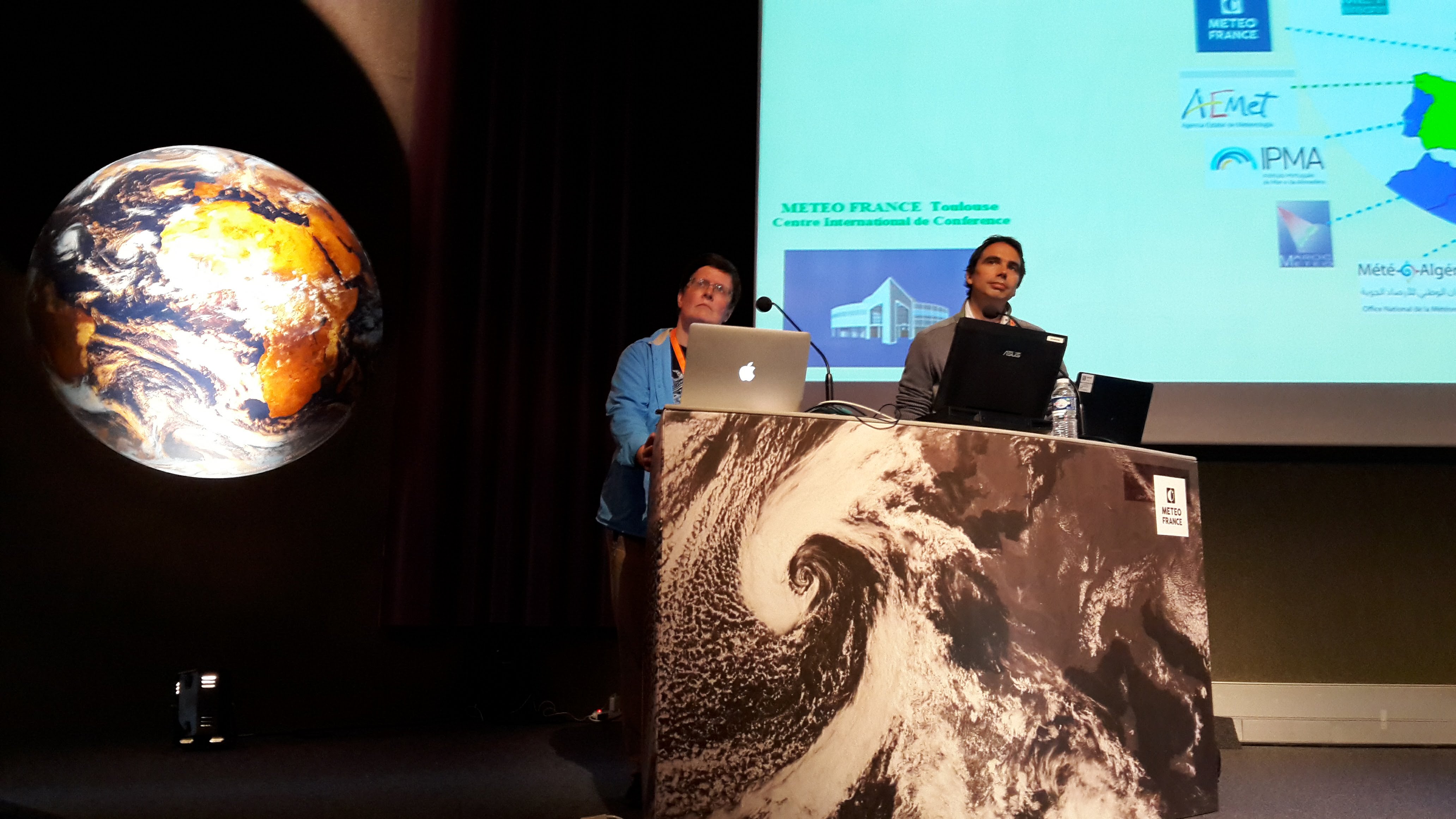
28th Wk&ASM 2018 : PMs at the closing session
|

|
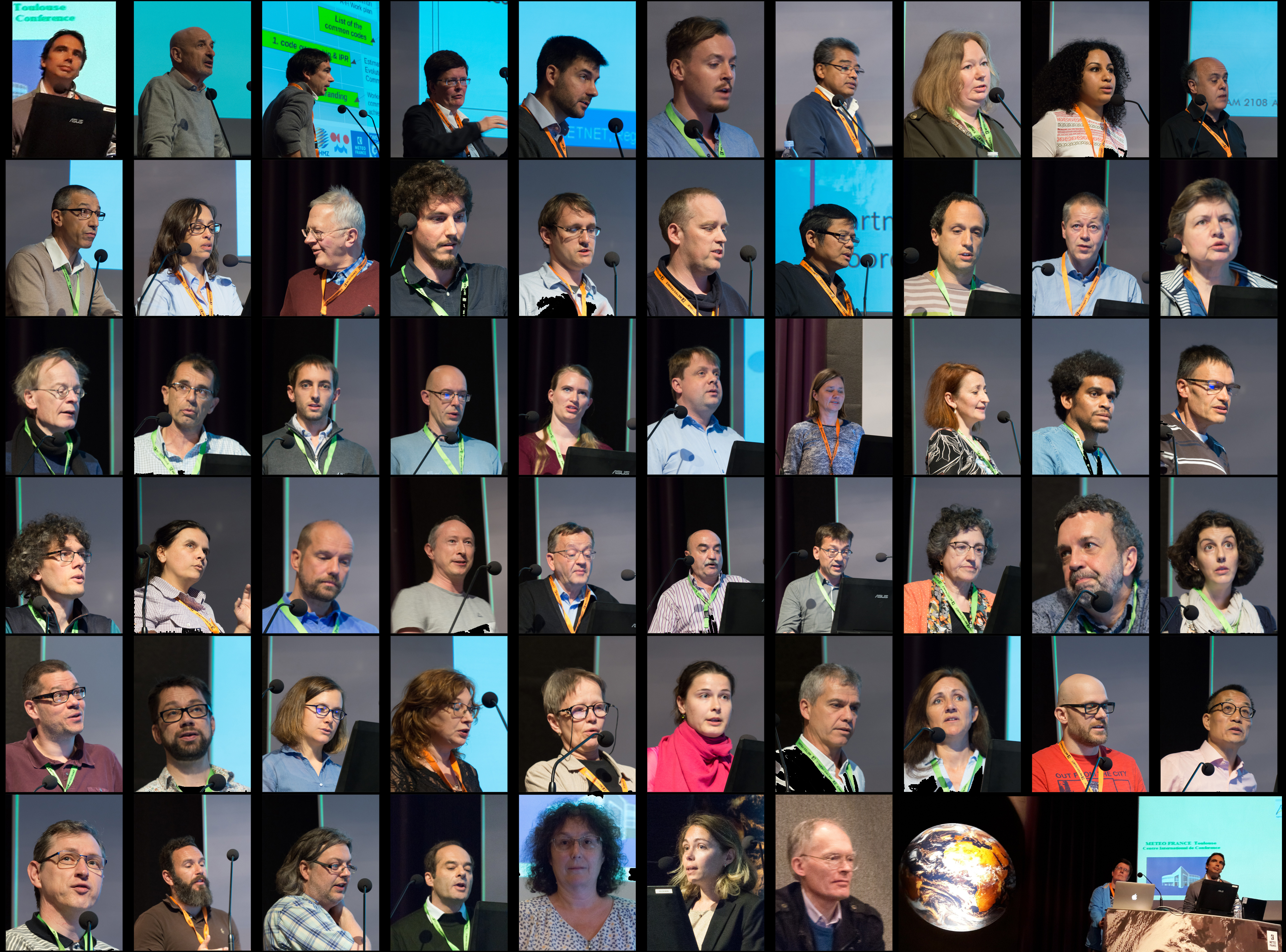
28th Wk&ASM 2018 : speakers
|
Agenda with link to the presentations (videos and pdf files)
- Plenary opening session. Video of the opening session
- Opening of the Meeting & Welcome speech
- Piet Termonia: ALADIN status overview
- Jeanette Onvlee: HIRLAM highlights of the past year
- Balazs Szintai: Status of the EUMETNET C-SRNWP project
- Plenary session 1: Data Assimilation. Video of the data assimilation session (first part)
- Yann MICHEL: The future EnVar scheme for the AROME model
- Roger RANDRIAMAMPIANINA: Upper-air data assimilation in HIRLAM, status and plan
- Jelena BOJAROVA: Flow-dependent data assimilation in HARMONIE forecasting system
- Wafa KHALFAOUI: Impact of an improved background-error covariance matrix with an AROME 3DVAR system over Tunisia
- Carlos GEIJO: Balancing Initial Conditions with Variational Constraints. First Results with 3D-Var and LETKF
- Jean-Francois MAHFOUF: Ongoing developments on the use of observations in the AROME 3D-Var
- Plenary session 1 (cont.): Data Assimilation. Video of the data assimilation session (second part)
- Isabel MONTEIRO: ASC2AT Assimilation Experiments with HARMONIE-AROME mesoscale model over Iberian Peninsula
- Sigurdur THORSTEINSSON: Use of low peaking channels from AMSU-A and AMSU-B over ice
- Phillip SCHEFFKNECHT: Assimilation of Mode-S Data for High Resolution Simulations
- Benedikt STRAJNAR: Impact of Mode-S EHS observations in ALADIN
- Trygve ASPELIEN: On the use of amateur weather observations in an operational nowcasting and NWP framework
- Xiaohua YANG: C3S Copernicus Arctic Regional Reanalysis system
- Plenary session 2: Physics. Video of the physics session (first part)
- Yann SEITY: Recent work on AROME physics
- Sander TIJM: HARMONIE-AROME forecast model developments
- Radmila BROZKOVA, Neva PRISTOV: ALARO-1 Canonical Model Configuration developments and tests
- Luc GERARD: Reconnecting cloud representations in Alaro-1
- Plenary session 2 (cont.): Physics. Video of the physics session (second part)
- Eric BAZILE: What can we learn from GABLS4 ?
- Benoit VIE: Evaluation of the 2-moment scheme LIMA and recent developments
- Daniel MARTIN-PEREZ: Modification of cloud condensation nuclei in HARMONIE-AROME microphysical parametrization using CAMS outputs
- Bjorg Jenny ENGDAHL: Improved representation of supercooled liquid water in HARMONIE-AROME
- Kristian Pagh NIELSEN: Testing the snow albedo sensitivity in HARMONIE-AROME
- Plenary session 3: Dynamics. Video of the dynamics session
- Petra SMOLIKOVA: Dynamics in LACE
- Fabrice VOITUS: Exploring some alternatives to improve the robustness of mass-based SI Spectral NH system
- Karim YESSAD: An alternate way to treat Melmholtz equation in the NHEE model
- Daan DEGRAUWE: The mass-based non-hydrostatic dynamics dwarf
- Martina TUDOR: LBC files - make and use
- WG on Climate
- Side meeting on surface physics and data assimilation
- Plenary session 4: Verification. Video of the verification session (first part)
- Christoph ZINGERLE: HARP Status and Plans
- Andrew SINGLETON: The future for point verification in HARP
- Bent SASS: HIRLAM-C activities on verification: Status and Plans
- Garcia-Moya JOSE A.: Verification of hourly precipitation using OPERA dataset
- François BOUYSSEL: Preliminary results with upgraded horizontal resolution in ARPEGE
- Plenary session 4 (cont.) : Verification. Video of the verification session (second part)
- Angeles HERNANDEZ: Simulated MSG SEVIRI imagery from the HARMONIE-AROME model
- Joel STEIN & Fabien STOOP: New neighborhood-based contingency tables
- Ines SANTOS ATIENZA: Assessment of HARM-AROME model at 1.0 km over the Spanish coast for wind forecast
- Danijel BELUSIC: Large spatial spin-up at inflow boundaries in HCLIM-AROME
- Discussion (side-meeting announcement)
- Plenary session 5 : Surface. Video of the surface session
- Patrick LE MOIGNE: SURFEX
- Patrick SAMUELSSON: Overview of HIRLAM surface activities
- Camille BIRMAN: Meteo-France operational land surface analysis for NWP: current status and perspectives
- Ekaterina KURZENEVA: Performance of FLake in HARMONIE
- Laura RONTU: Status of subgrid-scale orography parametrizations ororad and orotur in HARMONIE-AROME
- Margarita CHOULGA: Anthropogenic influence to continental land surface stocks and fluxes
- Patrick LE MOIGNE: ECOCLIMAP Second Generation
- Plenary session 6: EPS. Video of the EPS session
- Inger-Lise FROGNER: HarmonEPS developments
- Martin BELLUS: LAM-EPS activities in LACE
- Yann MICHEL: The AROME EDA: formulation and impact on the deterministic AROME 3DVar
- Yong WANG: Seamless ensemble forecasting from minutes to days
- Plenary session 7: System. Video of the system session
- Claude FISCHER: Cycles, mitraillette and the like
- Daniel SANTOS MUNOZ: HARMONIE-AROME system progress and evolution
- Roel STAPPERS: OOPS progress at ECMWF
- Ryad EL KHATIB: Object orientation in post-processing
- Plenary closing session. Video of the closing session
- Side meeting on HARP verification
- System side meeting : minutes
Posters
- Andrae Ulf : MetCoOp activities
- Azad Roohollah : ALERTNESS project: Advanced models and weather prediction in the Arctic
- Eric Bazile, Rachid Abida, Antoine Verrelle, Patrick Le Moigne, Cornel Soci, C. Szczypta: A 55 year surface analysis over Europe at 5.5km within the UERRA project
- Bojarova Jelena : Relevance of climatological background error statistics for meso-scale data assimilation
- Calvo Javier : The NWP system at AEMET
- Cedilnik Jure : ALADIN in Slovenia - 2018
- Clancy Colm : Operational NWP at Met Eireann
- Darcy Ronan : Operational NWP at Met Eireann
- Deckmyn Alex : National poster Belgium
- Derkova Maria : ALADIN related activities @SHMU
- Dumitru Alina : ALADIN Activities in Romania
- Feddersen Henrik : COMEPS - DMI’s short-range ensemble prediction system
- Gleeson Emily : Radiation Experiments using the ALADIN-HIRLAM System
- Gleeson Emily : Met Eireann’s high resolution experiments
- Guser Alper : Aladin Related Activities at TSMS
- Hdidou Fatima Zahra : Moroccan National poster
- Hdidou Fatima Zahra : GPS data assimilation in Morocco
- Horvath Kristian : Using spectral evaluation to assess the added value of higher resolution modelling
- Imrisek Martin : Data assimilation activities at SHMU
- Kolonko Marcin : Aladin in Poland
- Korpinen Anniina : Simulated effects of land-sea contrasts in Southern Finland
- Kovacic Tomislav : Radar data assimilation in Croatia
- MartÃnez-Sanchez Mauricia : AEMET-gammaSREPS: current operational status
- Medeiros Paulo : New Developments in OBSMON
- Monteiro Maria : ALADIN - Portuguese Technical and Scientific Activities
- Odak Plenkovic Iris : Deterministic post-processing of ALADIN NWP in Croatia
- Pottier Patricia : NMW systems at Meteo-France
- Randriamampianina Roger : Radar for Improving Precipitation Estimates and Optimization of Hydropower Energy Production (RadPrO)
- Ricard Didier : Impact of turbulence representation on deep convection
- Santos Atienza Ines : Verification of HARM-AROME model at 1.0 km over Spanish harbour areas
- Szucs Mihaly : NWP at the Hungarian Meteorological Service
- Trojakova Alena : NWP activities at CHMI
- Tsenova Boryana : Status of NWP in Bulgaria
- Tudor Martina : Operational forecast using ALADIN System in Croatia in Spring 2018
- Valkonen Teresa : Physiographic data sets in AROME-Arctic
- Wafa Khalfaoui : NWP Activities in Tunisia
- Whelan Eoin : SAPP: Evaluation for Operational NWP
- Wittmann Christoph : NWP related activities in Austria
Registration and participants
- Deadline for registration was 15 February 2018. If you are not registered and plan to attend, please contact the organisers.
- list of registered participants
Practical information
- The Meteo-France International Conference Center
- How to reach the Conference center
- Where to stay : please consult the list of available hotels

About ESOF Toulouse 2018
The biennial European event, EuroScience Open Forum (ESOF) will take place in Toulouse, "European City of Science" from 9 to 14 July 2018. "Sharing science: towards new horizons" will be the motto of this ESOF 2018 edition, a 6-in-1 event including various sections “Science†, “Science policy†, “Science to Business†, “Careers†and “Media & Science Communication†and a “Science in the City†programme dedicated to the general public. A series of themes covering all fields of science and their relations with society are covered by this multidisciplinary event through conferences, exhibitions and satellite events. www.esof.eu